Supercharge Your Internal IT Team Without Replacing Them
Your internal IT team knows your business. We give them the tools, coverage, and strategic depth to punch above their weight class. Co-managed IT from Schilling IT fills the gaps - after-hours support, AI-powered security, strategic advisory, and specialized project execution - so your team can focus on what they do best.
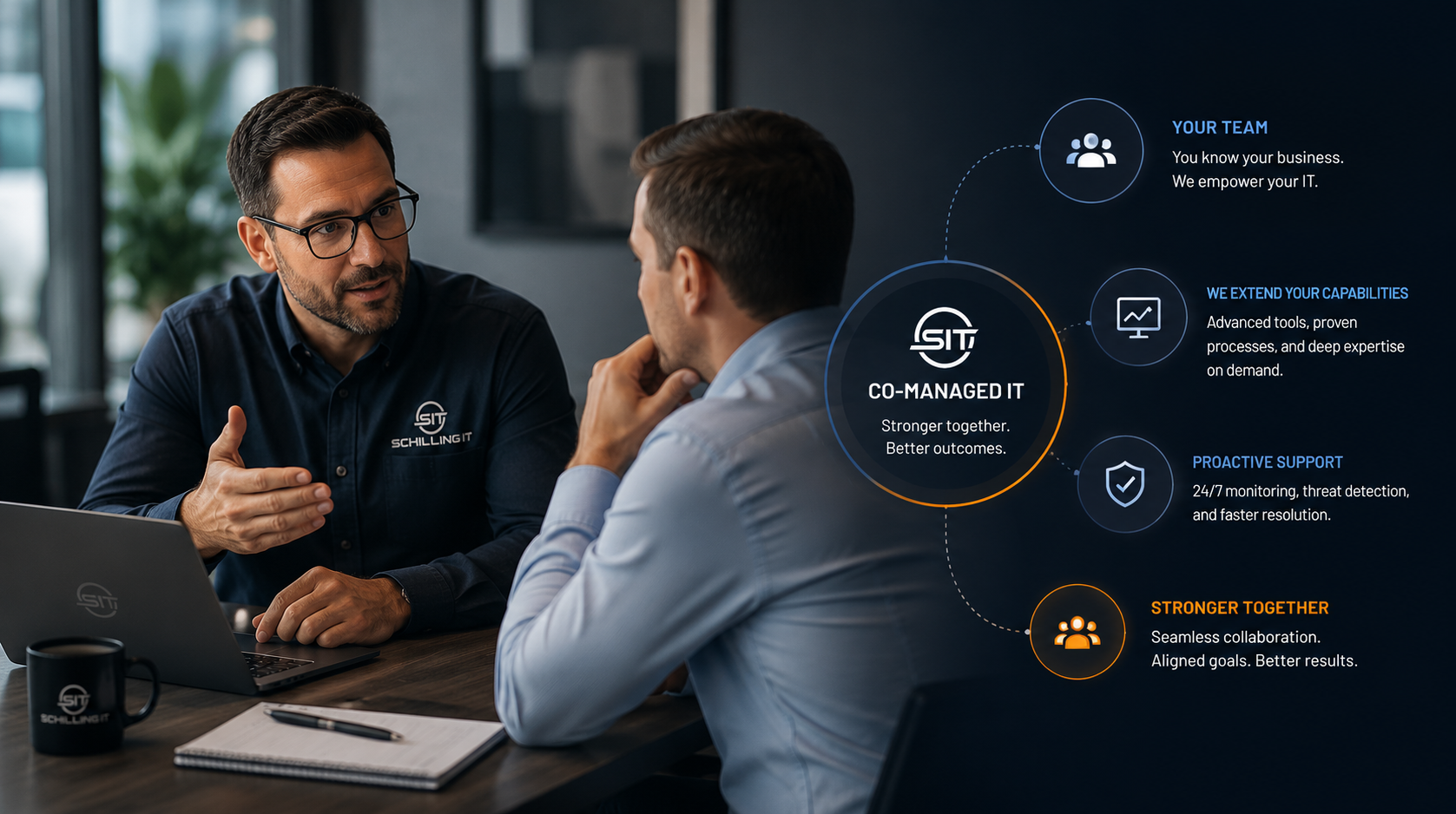
What Co-Managed IT Brings to Your Team
Every co-managed IT engagement is built around your existing team's strengths. Here's what we add to the partnership.
True Partnership Model
We work alongside your internal IT staff - not over them. Your team stays in control of strategy and relationships; we fill the gaps in capacity, expertise, and after-hours coverage.
Enterprise Security Stack
Your internal team gains access to our full cybersecurity toolset - AI-powered EDR, SIEM, dark web monitoring, and compliance frameworks - without the enterprise price tag.
After-Hours & Overflow Coverage
When your IT team is off the clock, we're not. We handle after-hours alerts, weekend emergencies, and overflow tickets so your staff doesn't burn out covering everything alone.
AI & Automation Enablement
We bring our AIOps platform to your environment - automated patching, predictive alerting, and AI-assisted ticket resolution - giving your team leverage they couldn't build alone.
Strategic Advisory & Planning
Your internal IT manager is great at keeping things running. Our strategic advisory layer adds the IT roadmap planning, vendor negotiation, and board-level reporting that most internal teams don't have bandwidth for.
Specialized Project Execution
Cloud migrations, infrastructure upgrades, compliance audits, M365 rollouts - when your team needs specialized depth for a project, we step in as a seamless extension.

Your IT Manager Stays in Charge. We Make Them Unstoppable.
Most IT managers we partner with are sharp, capable people who are simply stretched too thin. They know their environment better than anyone - the quirky server in the back room, the vendor who actually picks up the phone, the executive who needs extra patience on a Monday morning.
What they don't have is a team behind them. No one to cover the 2 AM alert. No one to run a compliance audit while they're handling a network outage. No one to build the IT roadmap the board keeps asking for. That's exactly where we come in - not to replace them, but to give them the backup they've always needed.
What Happens When Your One IT Person Is Gone?
If your entire IT operation depends on one person - and that person takes a vacation, gets sick, or resigns - your business is exposed. No one knows the passwords. No one knows the vendor contacts. No one knows why the server in the closet has a sticky note that says "don't restart." This is called key person risk, and it is one of the most common and most preventable IT vulnerabilities for growing businesses.
Who handles the after-hours alert when your IT person is at the beach?
A two-week absence can leave critical systems unmonitored and tickets unanswered.
The average IT professional tenure is under 3 years. Is your environment documented if they leave tomorrow?
Co-managed IT eliminates key person risk by design. Your environment is documented, monitored, and covered by a full team - so a single absence never becomes a business crisis.

The Responsibility Model That Actually Works
Co-managed IT is not about replacing your team. It is about giving them the right partner for every layer of the stack.
| Responsibility Area | Your Internal IT | Schilling IT Co-Managed |
|---|---|---|
| Day-to-day helpdesk & user support | ||
| After-hours & weekend coverage | - | |
| Vendor relationships & institutional knowledge | - | |
| Enterprise security stack (EDR, SIEM, dark web monitoring) | - | |
| Patch management & vulnerability scanning | - | |
| Strategic IT roadmap & planning | - | |
| AI & automation enablement (Copilot, AIOps) | - | |
| Compliance documentation (HIPAA, NIST, cyber insurance) | - | |
| Major project execution (migrations, upgrades) | - | |
| Business context & culture | - |