Insights and Resources
What Is Shadow AI and Why Should Your Business Care?
Published 2026-06-05 by Mark Schilling · 6 min read
The AI Tools Your Team Is Already Using
Here's something most business owners don't realize: your employees are almost certainly using AI tools right now that you haven't approved, haven't reviewed, and may not even know exist.
ChatGPT. Google Gemini. Claude. Perplexity. Notion AI. Grammarly. Microsoft Copilot (the free version). The list grows every week. And while most of these tools are genuinely useful, the way employees are using them - pasting in client data, financial records, internal memos, proprietary processes - creates real legal and security exposure for your business.
This is what the industry calls Shadow AI: the use of AI tools within an organization without the knowledge, approval, or oversight of IT or leadership.
It's the AI equivalent of Shadow IT - and it's moving faster.
Why Shadow AI Is Different from Shadow IT
Shadow IT has been a known risk for years. Employees using personal Dropbox accounts, installing unapproved software, or connecting personal devices to company networks - IT teams have developed policies and tools to manage this.
Shadow AI is harder to catch and potentially more damaging for three reasons:
- The tools are free and frictionless. There's no purchase order, no IT ticket, no installation required. An employee can paste your client list into ChatGPT in 30 seconds from a browser tab.
- The data doesn't stay local. When an employee pastes text into a public AI tool, that data is typically transmitted to a third-party server, potentially used to train future models, and stored in ways your business has no visibility into.
- Most employees don't think it's a problem. Unlike downloading pirated software, using ChatGPT feels harmless - even helpful. There's no cultural alarm bell that goes off.
What's Actually at Risk
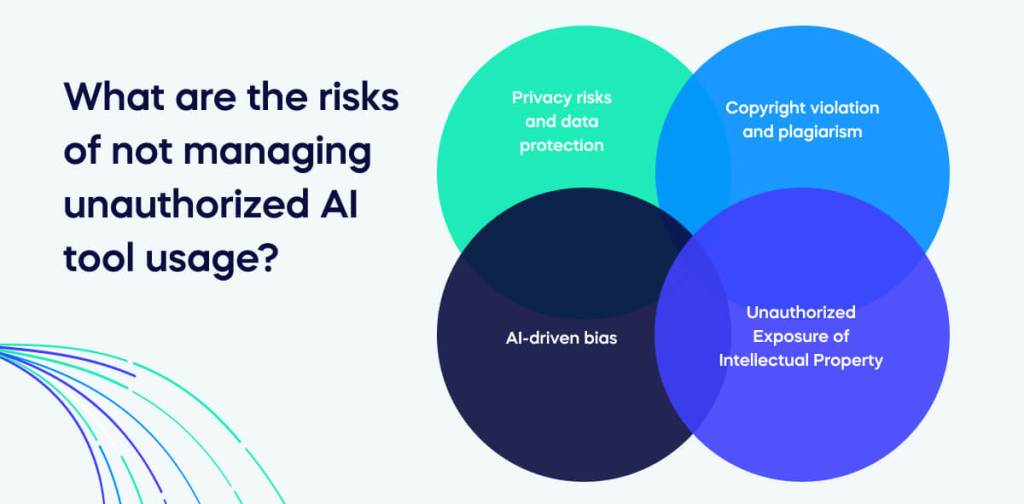
The risks aren't hypothetical. Here's what we see in practice when businesses haven't addressed Shadow AI:
Data Privacy and Compliance Violations
If your business handles protected health information (HIPAA), legal client data, financial records, or any personally identifiable information, pasting that data into a public AI tool is almost certainly a compliance violation. HIPAA doesn't care that the employee meant well. Neither does your cyber insurance carrier.
Intellectual Property Exposure
Proprietary processes, pricing models, unreleased product details, client contracts - when these get fed into a public AI model, you lose control of them. Some AI providers explicitly state that inputs may be used for model training unless you've opted out through an enterprise agreement.
Inaccurate Outputs Presented as Facts
AI tools hallucinate. They generate confident-sounding answers that are factually wrong. When employees use AI outputs in client-facing communications, proposals, or internal decisions without verification, the errors become your business's errors.
Vendor Risk Without Vendor Review
Every AI tool your employees use is a third-party vendor relationship - without the contract, the security review, or the data processing agreement. If that vendor has a breach, your data may be in it.
The Scale of the Problem
A 2024 survey by Salesforce found that 55% of workers report using AI tools at work that their employer hasn't approved. A separate study by Microsoft found that 78% of AI users are bringing their own AI tools to work rather than using company-sanctioned options.
For small and mid-sized businesses - where IT oversight is lighter and policies are less formalized - the exposure is proportionally higher.
The question isn't whether Shadow AI is happening in your organization. It almost certainly is. The question is whether you know about it and have a plan.
What Good AI Governance Looks Like
Addressing Shadow AI doesn't mean banning AI tools. That approach fails - employees will use them anyway, just more covertly. The goal is to move from unmanaged AI usage to governed AI usage.
Here's what that looks like in practice:
1. Establish an AI Acceptable Use Policy
A clear, written policy that defines which AI tools are approved, what data can and cannot be entered into AI tools, and what the consequences are for violations. This doesn't need to be a 40-page document - a one-page policy that employees actually read is more effective than a comprehensive one they don't.
2. Identify What's Already in Use
Before you can govern AI usage, you need to know what's happening. This means reviewing browser history policies, conducting an employee survey, and using network monitoring tools to identify AI tool traffic. Our Shadow AI Risk Assessment is a good starting point for understanding your current exposure level.
3. Provide Sanctioned Alternatives
Employees use Shadow AI because it solves real problems. If you ban ChatGPT without providing an alternative, you've created friction without solving the underlying need. Microsoft 365 Copilot, deployed through your existing M365 tenant, gives employees AI capabilities within a governed, enterprise-grade environment where your data stays in your tenant.
4. Train Your Team
Most employees who paste client data into ChatGPT aren't being malicious - they genuinely don't know it's a problem. A 30-minute training session on AI data hygiene, what's approved, and why it matters is often enough to change behavior significantly.
5. Review and Update Regularly
The AI landscape changes every few months. New tools emerge, existing tools change their data policies, and employee usage patterns evolve. AI governance isn't a one-time project - it's an ongoing practice.
Where to Start
If you're not sure where your organization stands on Shadow AI risk, the most useful first step is an honest assessment of your current exposure. We built a free 12-question Shadow AI Risk Assessment specifically for this - it takes about 3 minutes and gives you a scored risk report across four categories: AI policy, data privacy, governance, and culture.
No sign-up required. No sales call triggered. Just a clear picture of where you stand and what to address first.
Take the free Shadow AI Risk Assessment →
If your results show significant exposure - or if you'd like to talk through what an AI governance program looks like for a business your size - we're happy to have that conversation. Schedule a free assessment and we'll start there.